A First-Timer’s Listening Plan for a Village Hall Concert
A first-timer’s listening plan for a village hall concert: arrive with one question, follow a change in the programme and leave with one moment to remember.
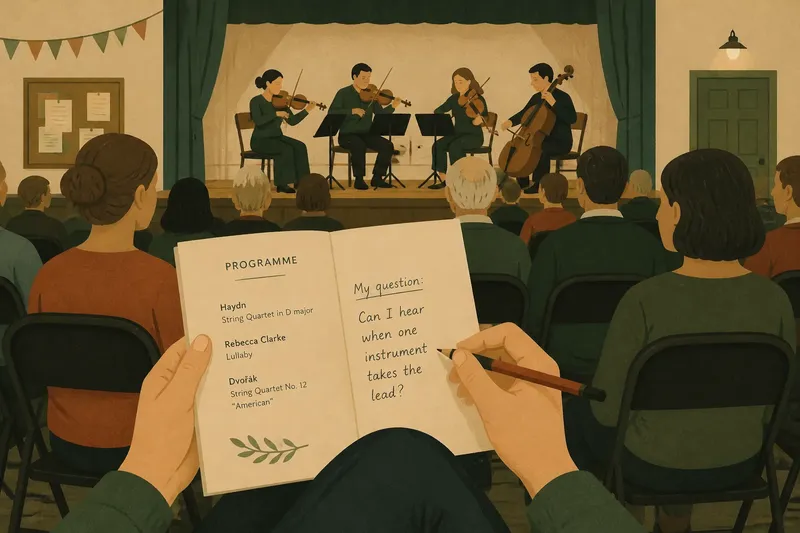
The folding chairs are nearly full, a programme rests on your knee and the musicians are tuning at the front. If this is your first village hall concert, a simple listening plan can give you something to follow without turning the evening into a test: arrive with one question, notice how the programme changes, then choose one moment to remember.
You do not need to know musical terms or recognise every tune. The hall, the printed programme and the sounds in front of you give you enough to work with. Treat the plan as three small invitations, not tasks you must complete perfectly.
What should I do before the music begins?
Arrive with one question you genuinely want answered. It can be as ordinary as, “Which instrument will I hear most clearly?” or “Will the quieter pieces hold my attention?” A question gives your listening a starting point, while leaving room for the music to surprise you.
Choose a question that does not depend on specialist knowledge. You might wonder how a familiar melody sounds on an instrument you rarely hear, how the mood changes between pieces, or whether the performers speak to the audience. Avoid questions with a right-or-wrong answer. The point is to notice, not to prove that you know something.
Before the concert, glance at the programme. Look for the performers’ names, the instruments listed and the order of the pieces. You do not need to read every note of background information. If a title catches your eye, keep it in mind; if the titles mean little to you, that is fine. You can listen without knowing a piece’s history.
Give yourself enough time to settle. Find your seat, put away anything that will distract you and let your eyes adjust to the room. A village hall may still have ordinary details in view: a stage curtain, a noticeboard or a familiar door. You do not have to ignore them. Let the room become the place where you are listening, rather than a problem to solve.
Say you have never heard a string quartet live and feel unsure what to watch. Your question might be, “Can I hear when one instrument takes the lead?” As the players begin, you can listen for the melody moving between them. If you hear it clearly, your question has opened a door; if not, you still have a useful thread to follow.
Write the question on the programme margin if you like, or keep it in your head. One is enough. A long list can pull your attention away from the music you came to hear.
How can I follow an unfamiliar programme?
Listen for change rather than trying to identify every sound. Notice whether a piece becomes louder or softer, quicker or more spacious, busier or more spare. These changes are available to any listener, even when the instruments or musical forms are unfamiliar.
When one piece ends and another begins, give yourself a moment to reset. Look at the next title or performers’ names, then listen for what has changed. A solo instrument may give way to a group. A lively passage may be followed by a quieter one. You can compare what you hear with the question you brought, but you do not need to judge which piece is better.
Try listening in layers. First, take in the overall character: does the music feel bright, restrained, playful or unsettled to you? Then attend to one detail, such as a repeated rhythm, a held note or a tune that returns. On another piece, choose a different detail. This keeps your attention flexible without requiring you to track everything at once.
Watch the performers only when it helps you listen. A bow lifting, a breath before an entrance or one musician turning towards another can make a change easier to hear. If watching makes you lose the sound, look back towards the stage or close your eyes briefly. Neither approach is more correct; use the one that suits your attention.
The printed programme can help you understand the shape of the evening, but it is not a scorecard. Some programmes give a short note about a piece; others simply list titles and names. Read a note if it adds interest, then return to the performance. You are allowed to enjoy a passage before knowing anything about it.
If the music seems difficult to follow, narrow your focus. Choose one instrument, one repeated sound or one contrast between sections. A small point of attention is often easier to hold than the whole piece. If your attention wanders, simply begin again when you notice. There is no need to reconstruct what you missed.
What if I do not recognise the music?
You can still listen closely without recognising a tune. Follow its shape: does it rise, fall, pause or return? Notice how the performers use silence, how one sound answers another, or whether the same idea comes back in a changed form. These are observations, not technical claims, and they do not require you to name a style.
If you recognise a melody, notice what the live performance changes about it. The pace may feel different from a recording, or a phrase may sound more delicate when you hear it in the room. Let recognition add a point of comparison, rather than making you listen for an exact reproduction.
There is no need to pretend that every piece has caught you. A passage may leave you puzzled, or you may prefer one performer or mood to another. Keep your first reaction open for a little while: a sound that seems strange at the start may become more compelling as you hear its pattern. You can also accept that a piece is not for you and give the next one a fresh chance.
Audience customs can feel unfamiliar too. Follow the cue of the people around you when the music ends, and listen for any words from the performers. If you are uncertain whether a piece has finished, waiting a moment before joining the applause is a simple choice. No one needs to make a public display of expertise to belong in the room.
How do I choose one moment to remember?
After the concert, choose one moment that stayed with you. It might be a tune that seemed to hover, a sudden change in pace, the sound of a particular instrument or the quiet just before applause. It need not be the most impressive passage, and you do not have to explain why you liked it.
Make the memory specific enough to find later. Instead of writing “the music was lovely”, note “the low notes under the quick melody” or “the pause before the final piece”. If you know the piece’s title, add it. If you do not, describe the sound or where it came in the programme.
You can make a note on the programme, in a phone note after the performance, or in a short message to someone you came with. Keep it brief. The purpose is to carry one clear detail away, not to produce a review of the whole evening.
That memory can help you decide what you want from another concert. Perhaps you would like to hear the same instrument again, try a programme with more variety or simply return to the hall for another evening. You do not have to turn the choice into a plan straight away. A single remembered sound is enough to make the next concert feel less unfamiliar.
Do I need to prepare by listening to recordings?
No. Recordings can help if you are curious about a composer, instrument or piece, but they are optional. If you do listen beforehand, keep it light: hear part of a piece, notice what draws your attention, then arrive ready to hear the live version on its own terms.
Should I read the programme notes during the concert?
Read them before a piece or during a break if they help you settle into the music. If reading makes you miss sounds you want to hear, put the programme down and return to it later. You can follow the evening through listening alone.
What should I do if my attention wanders?
Pick up one sound again: a rhythm, a melody or the difference between two instruments. There is no need to catch up on every moment you missed. Returning to the music is enough.
Can I enjoy a concert without knowing classical music?
Yes. Ask a simple question, notice one change and keep one moment in mind afterwards. Knowledge of musical terms may add another layer, but it is not a condition for listening or enjoying the performance.
For a first-timer’s listening plan for a village hall concert, keep the three parts small: bring one question, notice one change in the programme and leave with one moment you can describe. You may remember a melody, a pause or the way the room fell quiet. That detail gives you a personal starting point for the next concert, without asking you to become an expert first.